Welcome to the Workshop
Hi everyone, I'm Justine — photographer, 25 years experience, and I've been shooting for the RCN for a long time.
I’m here today to help you get the best out of your brand new Canon R7.
Before we get started — let's go around the room. Tell me your name and how you'd describe your experience with cameras. Complete beginner? Used one a bit? Pretty confident? No wrong answers.
What we’re covering today:
How a camera works and what the exposure triangle is
Getting to know your Canon R7
Four scenarios hands on — portrait, group shot, still life and events
Cheat sheets for each scenario to take away
Let's get started.
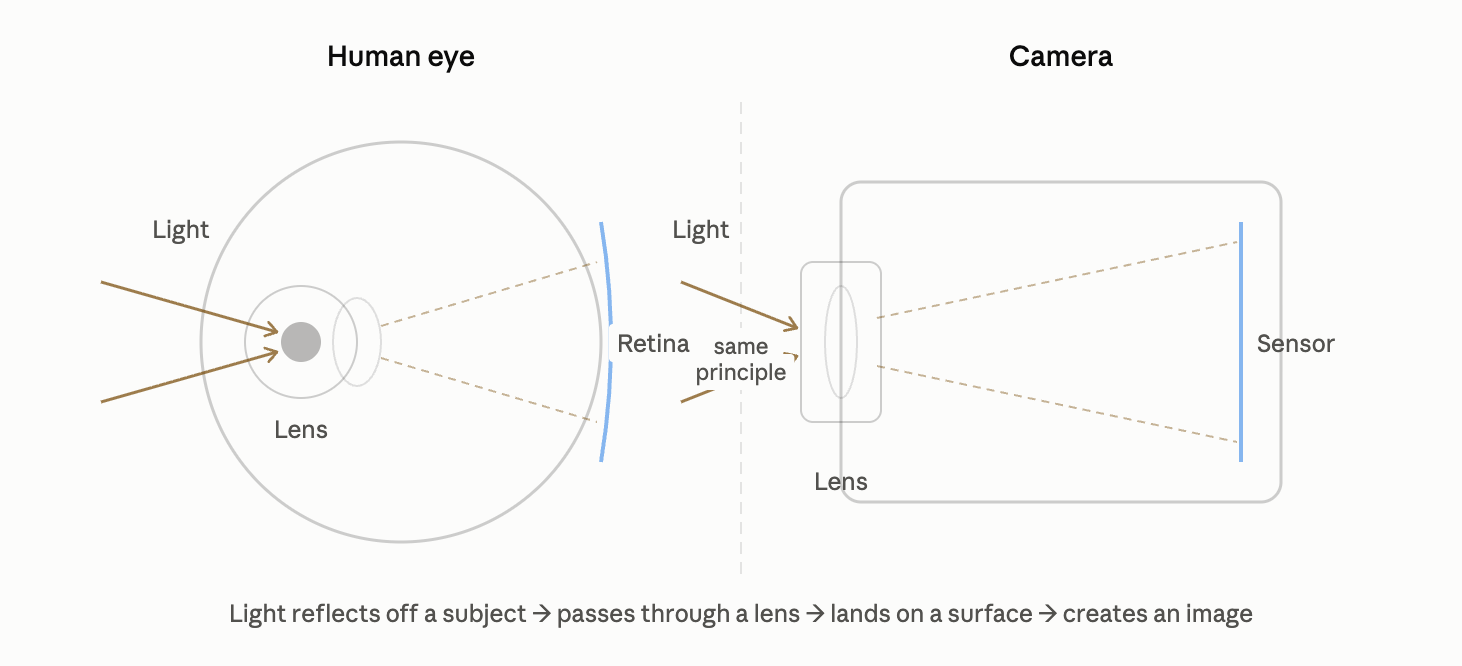
The one key difference
Your eye adjusts automatically — your pupil gets bigger in low light, smaller in bright light, without you thinking about it.
A camera can't do that on its own. You have to tell it how much light to let in — and that's where the exposure triangle comes in, which is what we're going to look at next.
How a Camera Works
A camera is modelled on the human eye. It's actually a really useful way to understand it.
Here's how your eye works:
Light from the sun hits an object and reflects into your eye
It passes through your lens and lands on your retina at the back of the eye
Your retina converts that light into signals your brain reads as an image
A camera works on exactly the same principle:
Light reflects off your subject and enters the camera through the lens
It passes through the lens and lands on the sensor — the camera's equivalent of the retina
The sensor converts that light into a digital image
The Exposure Triangle
*
The Exposure Triangle *
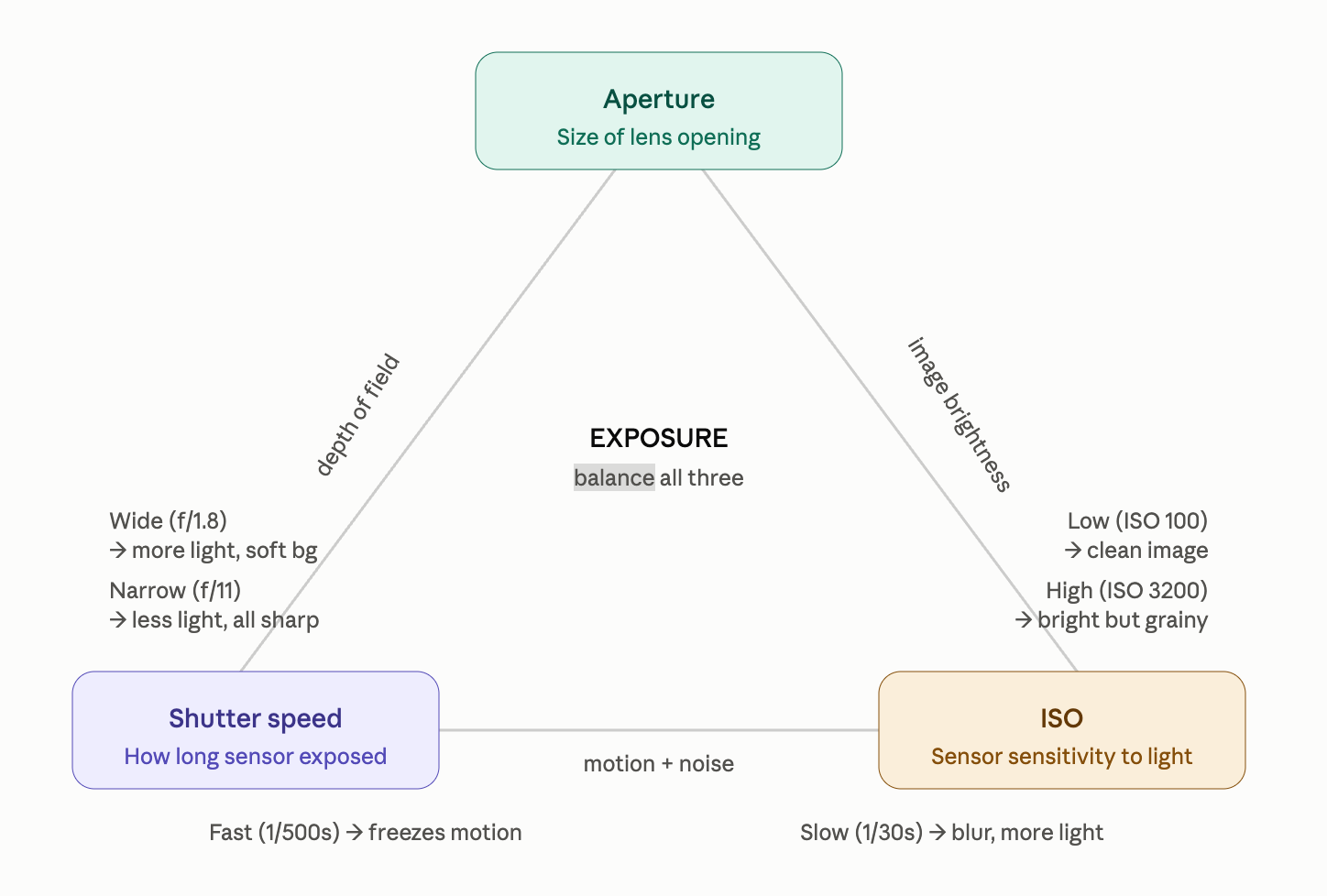
There are three things on your camera that control how much light hits the sensor. Change any one of them and your image gets brighter or darker. They are:
Aperture — the size of the opening in the lens. Bigger opening = more light in
Shutter speed — how long the sensor is exposed to light. Longer = more light in
ISO — how sensitive the sensor is to the light it receives. Higher = brighter image
Together these three things are called the exposure triangle. They work together — change one and it affects the others.
Why does this matter?
Getting the right exposure means balancing all three. Too much light and your image is washed out — overexposed. Too little and it's dark — underexposed.
The good news is you don't need to master all three today. For most of what you'll be doing with the R7 we'll be using Aperture Priority mode — which means you set the aperture and the camera handles the rest automatically.
We'll come back to exactly what that means when we look at each scenario.